When Supply Falls, Demand Moves
Heroin, fentanyl, and the limits of prescription-focused policy

For years, the opioid crisis has been explained as a supply story.
Too many pills. Too many prescriptions. Too much pharmaceutical marketing. Too many doctors willing to write the script.
There is truth in that account. Supply mattered. Pharma mattered. Pill mills mattered. Aggressive marketing mattered. Medical culture changed, and prescribing increased in ways that created harm.
But a supply-only explanation has always been too simple. It cannot explain why some communities were devastated while others were not. It cannot explain why overdose deaths continued to rise even after opioid prescribing fell sharply. It cannot explain why the crisis shifted from prescription opioids to heroin and then to illicit fentanyl. And it cannot explain why pain, disability, poverty, trauma, isolation, and economic dislocation are so often present in the background of addiction.
A provocative study by Amy Finkelstein, Matthew Gentzkow, Dean Li, and Heidi Williams helps clarify the issue—but only if it is read carefully.
The paper, What Drives Prescription Opioid Abuse? Evidence from Migration, examines adults receiving Social Security Disability Insurance who were enrolled in Medicare Part D between 2006 and 2015. The authors ask a powerful question: what happens when people move from one state to another? If a person moves from a low-opioid-use state to a high-opioid-use state, does that person’s opioid use pattern begin to resemble the new place?
Their answer is yes.
People who moved to states with higher rates of claims-defined prescription opioid “abuse” became more likely to show similar claims patterns after they moved. The effect appeared quickly and continued to grow over time. In other words, the same person placed in a different environment behaved differently—or, more precisely, was treated differently, prescribed differently, monitored differently, or became embedded in a different medical and social ecosystem.
That is an important finding.
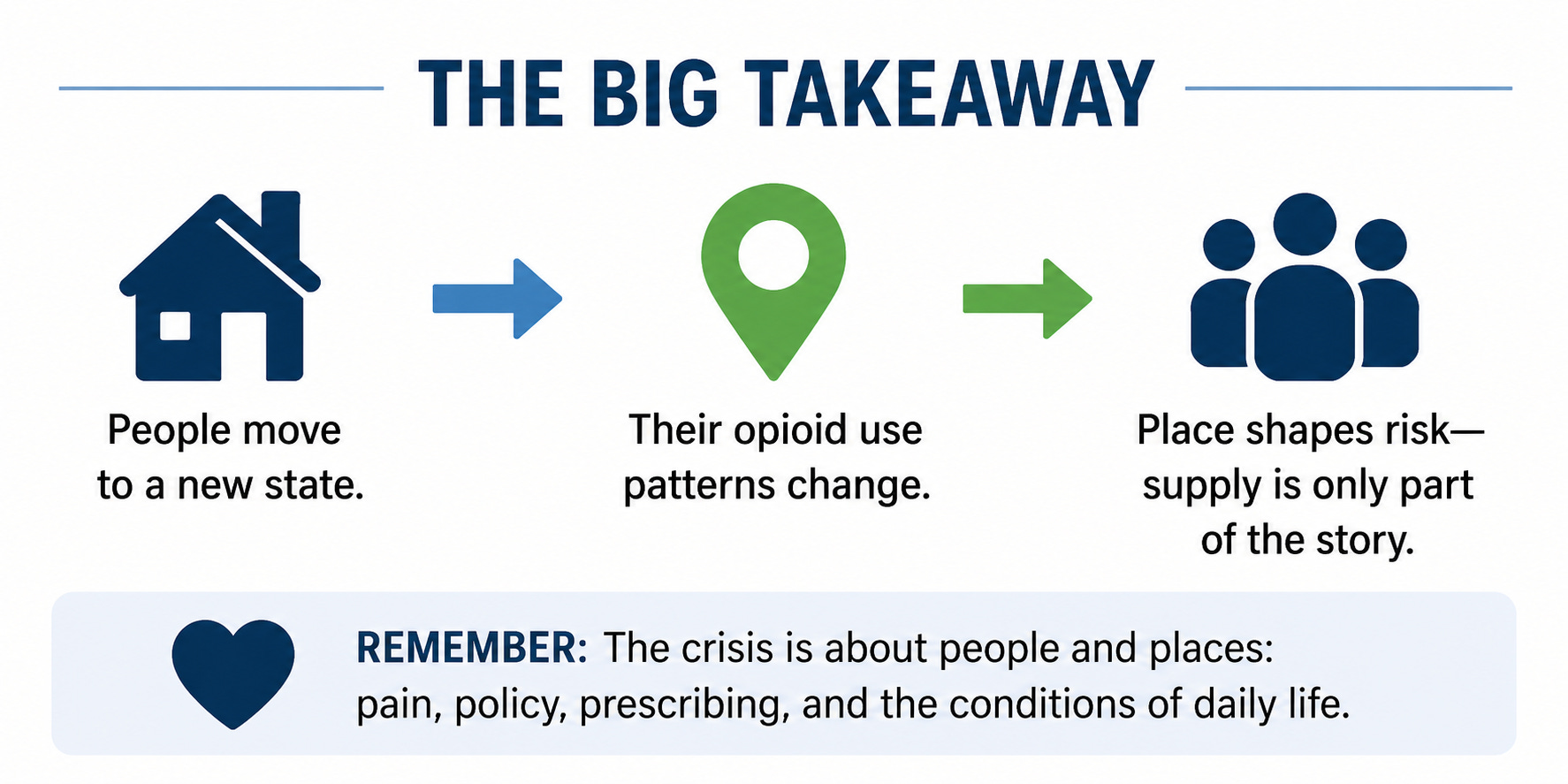
It means risk is not located only inside the individual. Place matters.
But what does “place” mean?
That is where the interpretation becomes more complicated.
In the study, “place” includes opioid availability, local prescribing patterns, physician practice style, policy environment, pill mills, peer effects, and other local factors that may influence prescription opioid use. These are not trivial distinctions. A pill mill is not the same thing as poverty. A permissive prescribing culture is not the same thing as untreated pain. A prescription monitoring program is not the same thing as social despair. But all of these can be part of the local environment in which opioid use occurs.
Two Pathways
The paper tries to separate two broad pathways.
The first is an availability pathway: how easily people already using opioids can obtain them. This is the part most people think of when they think about supply. If there are more prescribers, fewer controls, more pill mills, or weaker monitoring systems, opioids may be easier to obtain.
The second pathway is a modeled transition pathway: the factors associated with movement into claims-defined high-risk opioid use over time. It should not be read as direct evidence of addiction, physician intent, or inappropriate prescribing.
That distinction matters.
The authors use administrative claims data. Their primary outcome is not a clinical diagnosis of addiction, opioid use disorder, or compulsive use. It is a claims-based proxy. Their main measure defines prescription opioid “abuse” as an average daily morphine-equivalent dose greater than 120 mg in any calendar quarter. They also examine other proxies, such as multiple prescribers and overlapping prescriptions.
These measures may identify risk. They may correlate with adverse outcomes at the population level. They may be useful for epidemiologic analysis.
But they are not the same as a clinical assessment.
A high opioid dose may reflect unsafe prescribing. It may also reflect severe pain, tolerance, legacy therapy, failed alternatives, palliative needs, or a complex clinical history. Multiple prescribers may reflect doctor shopping. They may also reflect fragmented care, surgery, hospitalization, relocation, specialist involvement, or poor care coordination. Overlapping prescriptions may suggest misuse. They may also reflect dose adjustments, transitions between clinicians, acute-on-chronic pain, pharmacy timing, or insurance logistics.
Claims data can reveal patterns invisible at the bedside. But claims data cannot sit with a patient. They cannot assess function. They cannot distinguish relief from compulsive use. They cannot determine whether a prescription represents appropriate care, poor care, dependence, diversion, misuse, or abandonment.
This is the danger of converting administrative proxies into moral categories.
The Finkelstein study is valuable because it shows that geography matters. People do not carry all risk inside themselves. Their environments shape what happens to them. But the study should not be used to claim that high-dose prescribing automatically equals abuse, or that modeled transitions in claims data prove clinical addiction.
The language matters because policy often moves faster than nuance.
Once a prescription pattern is labeled “abuse,” the patient behind the pattern can disappear. A risk marker becomes a diagnosis. A population-level association becomes an individual judgment. A statistical proxy becomes a justification for restriction.
That is how toxic narratives are built.
The deeper lesson of the study should not be that people in high-prescribing states were simply abusing opioids because supply was available. Nor should it be that supply did not matter. The lesson is that opioid-related harm emerges from the interaction between people and places.
The same person may experience different risks depending on where they live. The same prescription may have different meaning depending on the clinical context. The same policy may reduce one form of harm while creating another. The same supply reduction may close a pill mill and also abandon a patient with severe pain.
This is why the opioid crisis cannot be understood as a simple three-act play: pills, heroin, fentanyl. Nor can it be reduced to villains and victims, doctors and dealers, supply and demand.
The Real Story is Ecological
There was supply. There was marketing. There was overprescribing. There were also patients with pain, disability, trauma, and despair. There were hollowed-out communities, fragmented health systems, inadequate addiction treatment, punitive drug policy, and a culture eager to find simple blame.
When prescribing was reduced, the underlying suffering did not disappear. In many places, it migrated into more dangerous markets.
That is why overdose deaths could continue to rise even as prescription opioid volume fell.
A supply-only strategy can reduce access to one drug source. It cannot heal despair. It cannot restore work, housing, connection, or trust. It cannot build treatment systems where none exist. It cannot make pain care humane. It cannot reverse stigma. It cannot replace a dangerous illicit market with a functioning public health infrastructure.
The Finkelstein study matters because it provides quantitative evidence that geography shapes prescription opioid patterns. But its deeper value is not that it gives us a simple supply-versus-demand answer. It does not. Its value is that it points us away from the individual alone and toward the environments in which opioid use becomes dangerous.
Place Now Matters
But place is not merely a prescription rate on a map. Place is the clinic that has time to listen—or does not. Place is whether a patient can access physical therapy, mental health care, addiction treatment, or transportation. Place is whether a community has jobs, housing, and social cohesion. Place is whether a person in pain is believed. Place is whether policy responds to suffering with care or suspicion.
The question is not whether supply or demand caused the opioid crisis.
The better question is: what conditions allowed opioid supply to become so harmful, and why were some people and communities so vulnerable to that harm?
That question leads us away from blame and toward prevention. It leads us away from slogans and toward systems. It reminds us that the opposite of addiction is not merely abstinence or reduced prescribing. It is stability, connection, purpose, care, and relief from suffering.
Supply Mattered
But supply became catastrophic because it entered environments already primed for harm.
That is the story we still have not fully confronted.