Britney Spears’ SUD
Anyone Can Be Vulnerable


The recent New York Times coverage of Britney Spears’ misdemeanor DUI charge—stemming from her March arrest involving alcohol and drugs—has once again thrust her long-public battle with substance use and mental health into the spotlight. Reports have revisited her 2008 conservatorship, her voluntary entry into treatment, and passages from her 2023 memoir in which she describes Adderall as her “drug of choice” because it briefly lifted her depression.
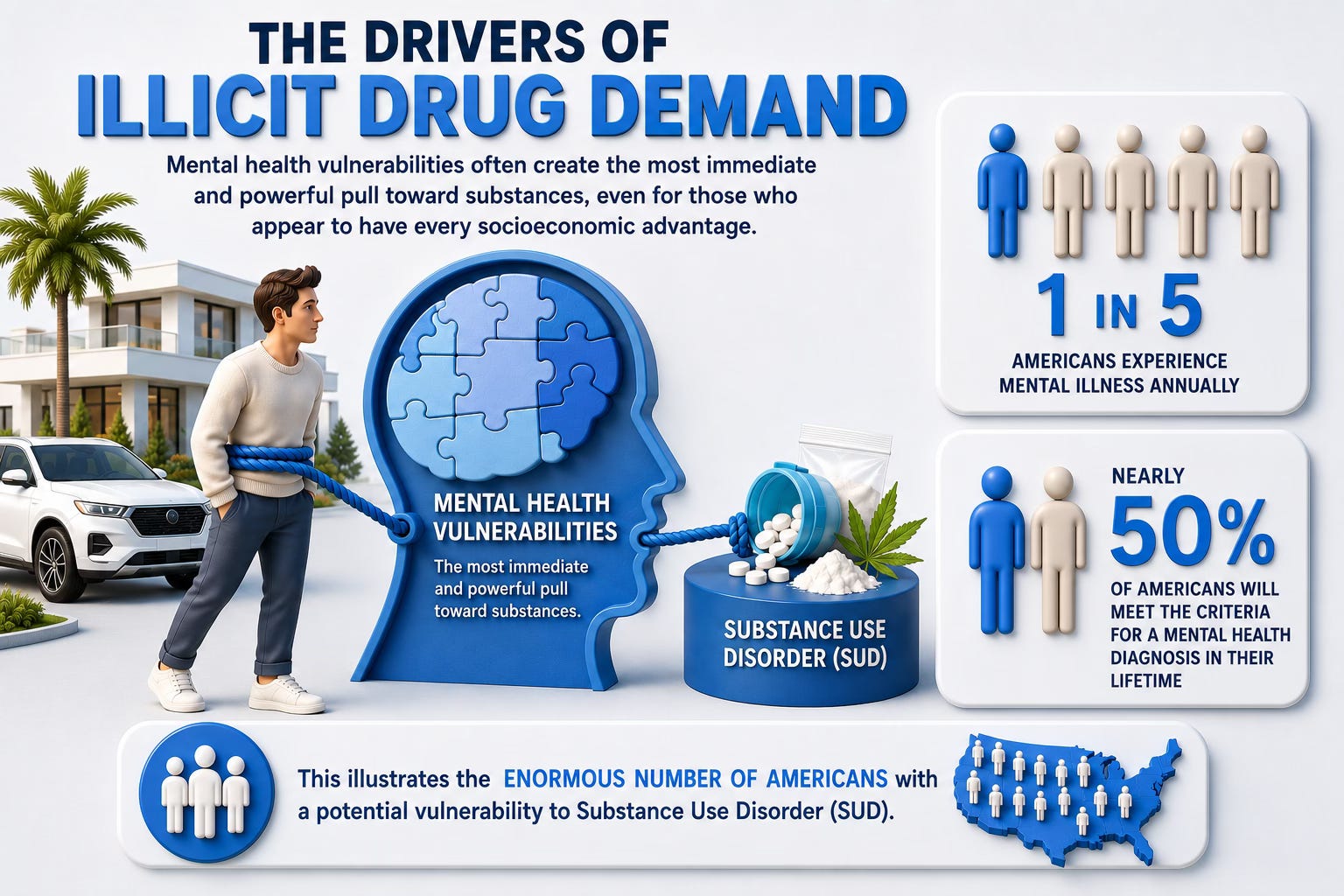
This story offers a lens into the drivers of illicit drug demand. Mental health vulnerabilities often create the most immediate and powerful pull toward substances, even for those who appear to have every socioeconomic advantage. More than one in five Americans experience mental illness annually and nearly 50% of Americans will meet the criteria for a mental health diagnosis in their lifetime. This illustrates the enormous number of Americans with a potential vulnerability to substance use disorder (SUD).
Despite her modest beginnings, Spears is now—by any measure—extraordinarily privileged. She has known immense wealth, global fame, and access to the kind of elite medical care and resources most can only imagine. She does not fit the common image of someone driven to drugs by economic hardship or structural despair. And yet her struggles continue, a poignant reminder that while poverty and disadvantage are clear risk factors for SUD, privilege offers no immunity. Wealth and status do not protect anyone from the internal torment of untreated mental illness or trauma.
At the heart of her experience are the internal drivers so many face: untreated or poorly managed mental illness, deep trauma, and the desperate urge to self-medicate. Her memoir, The Woman in Me, and public accounts describe severe postpartum depression after the births of her sons, a widely witnessed 2007 breakdown tied to that overwhelming perinatal mood disorder, and reports of a bipolar disorder diagnosis that involved lithium treatment. She has spoken candidly about turning to Adderall not for thrills, but because it offered a fleeting sense of relief from depression, calling it “the only thing that worked for me as an antidepressant” at the time. This is textbook self-medication, a profoundly human attempt to ease unbearable psychic pain when legitimate mental health support feels out of reach, fragmented, stigmatized, or even coercive.
In my previous Substack post, “The Opioid Crisis Driven by Demand, Not Just Supply,” I discussed how supply-side interventions alone cannot solve the drug crisis because they fail to address the underlying demand. Here again, demand is central. Spears illustrates this clearly: no one flooded her with unwanted pills or pushed Adderall into her life. She actively sought out substances to cope with her pain. Supply was available, but the drive came from within.
Layered onto this are significant traumas: relentless paparazzi harassment, painful custody battles, and a conservatorship she has described as deeply controlling and abusive. When emotional pain becomes overwhelming, substances—whether alcohol or illicitly obtained stimulants—can feel like the only source of immediate relief, even if they ultimately deepen the suffering. The brain’s drive for comfort does not pause to consider privilege or fame; it simply seeks to survive the hurt.
Spears is not an outlier; she represents countless “hidden” individuals who appear successful on the outside while grappling with an inner pain that drives them toward illicit substances. Emphasizing mental health risk factors helps us reject the false idea that those with privilege who struggle must simply lack willpower. Instead, her story illuminates central truths: the biological pull of addiction does not respect wealth or fame, trauma touches every community, and mental health care remains inadequate and stigmatized at every level of society.
She deserves compassion, not punitive judgment. Her life has unfolded under a microscope, turning private pain into a spectacle that would test anyone’s resilience. Recognizing her humanity—rather than condemning her as a symbol of excess—allows us to see her story for what it is: a profoundly human attempt to soothe psychological suffering.
To truly address the demand for illicit drugs, we must confront these mental health roots. Greater access to affordable, high-quality mental health treatment is essential if we are serious about solving this crisis. By responding with empathy instead of condemnation, we can foster more effective prevention, treatment, and policies that actually meet people where they hurt.
At a Glance
I’m pleased to announce that on May 26, my latest book, Deconstructing Toxic Narratives will be available through various sellers. Click here to learn about it.
If you missed my launch post, here it is:

And here is my previous post

Very interesting and I hear so many patients in chronic pain unable to access treatment.
I really like the tone you're adopting in these pieces, Lynn, especially your emphasis on compassion. In a colloquial sense, I believe that people seek what they need; and that behind many discussions of "wellness" lurks a very dangerous assumption that anyone who needs medication for anything is somehow compromised or weak. Purity is not our natural state. We're all broken or incomplete in some way. Compassion is essential.